A river call is the cleanest decision in poker. No cards to come, no future streets, no implied odds. You either have the best hand or you do not, and the maths of whether to call is genuinely simple.
The part that is not simple is the input the maths needs, which is how often your opponent is bluffing. Get that wrong and a perfect calculation gives a wrong answer.
The arithmetic, once
You need to win often enough to cover the price you are being offered. The price is the bet divided by the final pot including your call.
If the pot is 100 and they bet 50, you are calling 50 to win 150, so you need to be good roughly a third of the time. If they bet the pot, 100 into 100, you are calling 100 to win 200 and need to be good half the time. A small bet of 25 into 100 needs you to be right about one time in five.
That is the whole formula. Smaller bets need you to be right less often, which is why small river bets get called so widely and why they are usually not bluffs.
The number that actually decides it
Knowing you need to win a third of the time is useless until you estimate how often this opponent turns up with a bluff at this node.
Against a balanced opponent, bluffing frequencies roughly match the price they are laying, which is what makes the call close by design. Against everybody else, the frequency is wrong in a direction you can exploit.
In loose-passive pools, river aggression is close to pure value. A player who has called two streets and then bets or raises the river is almost never bluffing there. That single population fact turns a lot of mathematically close calls into clear folds.
In looser, more aggressive fields, the opposite applies and over-folding becomes its own leak. Knowing which field you are in matters more than the arithmetic.
Work backwards through the hand
Before calling, ask what hands play this way, then check whether those hands beat you.
A player who checked the flop, checked the turn and bet the river usually has either a hand that improved or a missed draw giving up. A player who bet all three streets on a board where nothing completed has a narrower and stronger range.
The most useful question is which draws were available and whether any of them missed. Bluffs in recreational pools are overwhelmingly busted draws, and when no draw was possible, the credible bluff largely does not exist.
Blockers, briefly
Cards in your hand remove combinations from theirs. Holding the ace of the flush suit means fewer flushes are possible, which makes a call slightly better. Holding a card that completes their obvious straight makes it worse.
Blockers matter at the margin and are worth knowing. They are not worth much against opponents whose bluffing frequency is far from balanced, because the frequency error dwarfs the blocker effect. Learn the population first.
A worked hand
NL10 in Allin Zone on ClubGG, 6-max, blinds 0.05/0.10, and this hand is a bomb pot: everyone posts 3bb, no preflop action, five players see the flop with 15bb in the middle. Flop 8d 3s Th. We are on the button with Tc 9c, top pair and a gutshot. It checks to us and we bet a third of the pot, which is the right size into four players whose ranges are random two cards. Two call.
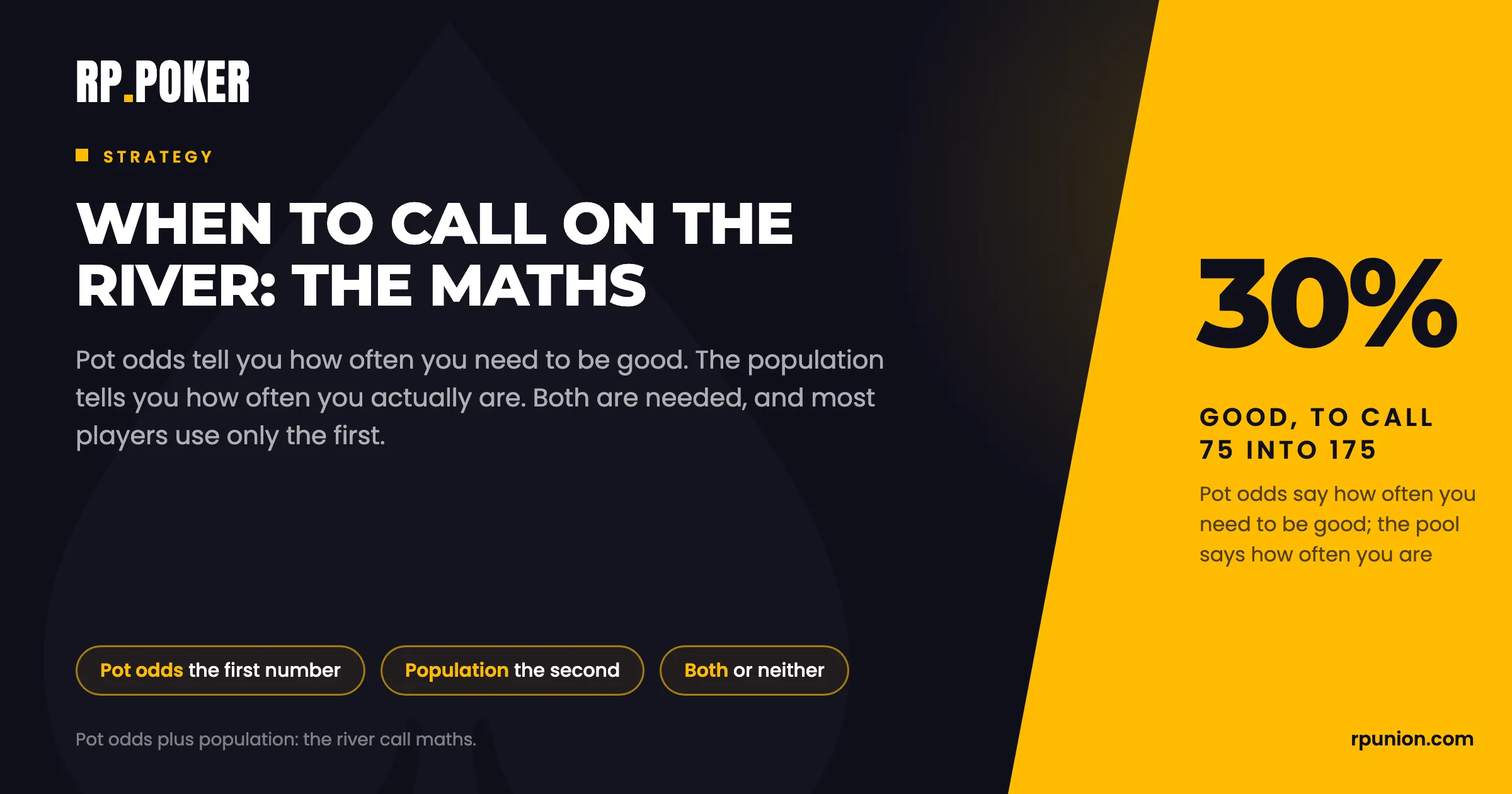
Turn 2c. Check, check, we check behind. With a one pair hand in a three way bomb pot there is nothing to build for and plenty to lose. River 7s. The small blind, who has been quiet all session, leads for 75 percent of the pot into two players. We are asked to call 75 into a pot of 175, so we need to be good about 30 percent of the time.
Fold. A lead of that size into two opponents on a river that completed nothing obvious is not a bluff in this pool. The hands that take that line in a bomb pot are two pair with 8x or Tx, sets of threes and twos, and the occasional 96 that got there. Busted draws here check and give up. The arithmetic said 30 percent. The estimate of his bluffing frequency said far below that, and the estimate is what decides the hand.
What this looks like in our clubs
River decisions in Allin Zone on ClubGG come with a piece of information most pools do not give you: the VPIP floor. Every player has to play at least 30 percent of hands at the low limits, which means a player who reaches the river has often started with a hand he did not choose. Those players bluff rivers less, not more, because the hand got there by rule rather than by plan, and they do not fire a third barrel with it. Folding to large river aggression from a quiet player is close to free money here.
Bomb pots are the exception in the other direction. Every ten hands the table sees a flop five or six ways with no preflop action, and ranges on those boards are wide and uncapped for everybody. A river bet in a bomb pot that has been checked through twice is almost always a made hand; a river bet in a bomb pot that has been bet every street by the same player is where the occasional bluff lives. Keep the two cases apart in your notes.
Frequently asked questions
How do I calculate whether to call on the river?
Divide the bet by the final pot including your call. That gives the share of the time you need to be best. A half-pot bet needs you good about a third of the time, a pot-sized bet about half.
Should I call more or less at low stakes?
Less, against passive players. In loose-passive pools river aggression is nearly all value, so hands that only beat a bluff should be folded even when the price looks tempting.
What does a small river bet usually mean?
Weak-to-medium value or a blocking bet, especially from a recreational player. They want a cheap showdown rather than a fold, which makes raising a reasonable response.
Do blockers matter much?
At the margin, and much less than getting the opponent's bluffing frequency right. Against unbalanced opponents the frequency error is far larger than any blocker effect.
How do I know if someone bluffs rivers?
Watch and write it down. Without tracking software in club apps, a note saying whether a specific regular has ever shown a river bluff is the most useful single read you can hold on them.
Where to start
For one session, before every river call, say what hands they would bet this way and whether those hands beat you. If you cannot name a bluff they would take this line with, fold.
To find out which of our fields folds too much and which bluffs too little, message @rpunion, or compare the pools across the apps we run clubs in.
18+. Play within your means.